Schlagwort: social media

  • Kids on Facebook – privacy first!

    The fact that kids under 14 are not allowed to join Facebook does not mean they are not present on the network. They often appear in image galleries published by their proud parents and they are sometimes even shared not only with “friends” but with larger audiences. Just recently, the Californian Social Media giant has even made it possible for expecting mothers to share their sweet anticipation in their profile settings. This is not always in the interest of the offspring and can even be risky, bloggers and social media groups point out.

    „Especially young women often exchange their profile picture for an image of their child“, says the author of the Austrian blog „Phänomen Facebook“. But the youngsters also appear on images in the newsfeed, stroking their first pet or learning to cycle, sometimes even with their names tagged. Given the age restrictions of Facebook, and the fact that this in almost all cases happens without the consent of the child, is not only legally questionable but also raises moral issues.

    „Also children have a right to privacy and data protection“, explains the blogger. Parents should publish images of their children only when they are older than 14 and with their consent. „Should the kids be younger, it is advisable to either not post their images at all or only those images that do not violate the interests of the children“, says Lukas Feiler, legal and IT expert. Which, of course, is a matter of private opinion and taste.

    This problem has also become apparent on YouTube over the last few years. Here, parents have uploaded videos showing their kids in embarrassing situations just to get a laugh. Some of these clips have fetched millions of clicks and could be embedded and downloaded by anyone. The repercussions for the unasked stars in their later lives cannot be predicted. Equally, on Facebook, the kid pics are shared with about 130 „friends“ – which is the average number of “friends” each Facebook user has. Legally, this can be called public in many countries (such as Austria), says Lukas Feiler.

    But also for mothers-to-be it is not advisable to announce their growing belly online – though it is, of course, understandable that young women want to share this exciting phase of their lives. However, it has to be considered that these news might not be warmly welcomed by employers and colleagues (although they will obviously find out in due course). There is, of course, also the slight possibility that the pregnancy might have an unlucky ending: a lot of questions and undesired phone calls could be the result.

  • „Facebook-parties“ – a few clicks between fun and drama!

    Invitations via Facebook have lead to escalating parties in various countries over the last few months, mostly because the hosts had forgotten to make the event private. In some instances, several thousands of people had accepted the invitation, leading to massive police operations in residential areas and cordoned-off neighbourhoods. In early June, a girl by the name of Thessa in Hamburg, Germany, wanted to celebrate her 16th birthday – she went into hiding after 1,600 revellers arrived in her neighbourhood.

    „This is a new form of youth culture“, Ralf Steger, Minister of the Interior of the German state of Northrhine-Westphalia, told the German press agency dpa. After recent riots at a Facebook party in the German city of Wupptertal, however, he advised to thoroughly check the privacy settings when announcing a bash over the social net.

    As soon as an invitation goes live via Facebook, it can easily go viral and unleash a snowball effect. The parents of the girl from Hamburg, for example, found out about the skyrocketing number of guests and quickly cancelled the party. By that time, however, the party had been reposted and spread over other online channels such as Twitter, and more than 15,000 people had already „confirmed“ they would attend.

    Despite public announcements that the party was called off, still one in ten showed up – wearing party theme shirts and singing „Where is Thessa?“. According to the Associated Press, eleven people were detained, one police officer was injured, a dozen girls wearing flip-flops cut their feet and two small fires had to be extinguished. „Nonetheless, the party was a hit“, police spokesman Mirko Schreiber confirmed.

    Last autumn a girl from Sydney, Australia, was in for an even worse drama. Within only a few days, her invitation had fetched 200,000 confirmations from potential party goers. Her party announcement, also sent out via Facebook, included related private details such as address and was swiftly reposted by an anonymous „friend“. On the announced day however, the police patrolled the neighbourhood and no reveller saw her house from the inside. Legislation differs from country to country, but most often costs for the police operation can be transferred to the party host.

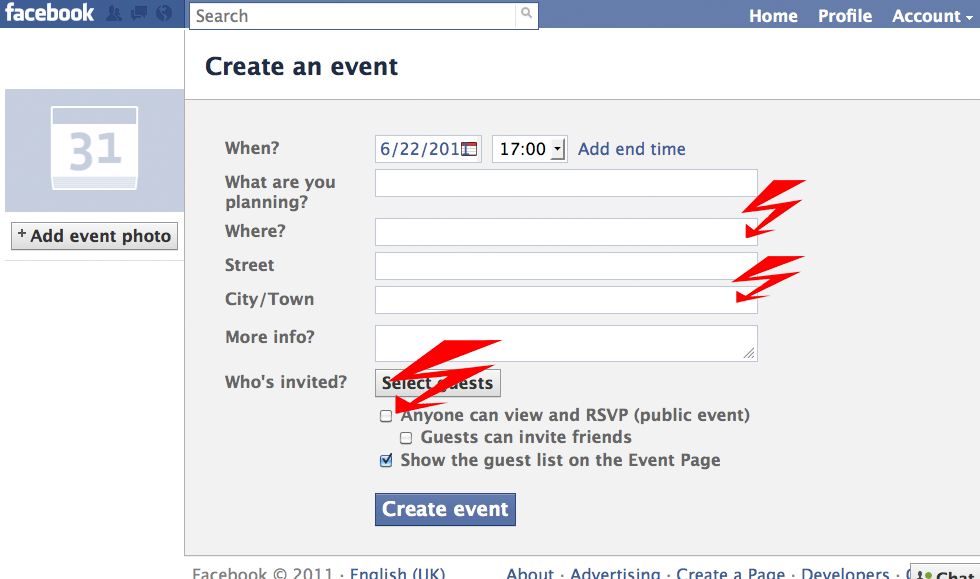
    eSafety experts recommend to instead send party invites via e-mail and only to close and trusted friends. If done by Facebook, however, the number of guests can be restricted. Click „Create an event“ – be careful not to send your private data or location of your home in an open invitation! It’s advisable to not give a phone number at all. Uncheck „Anyone can view and RSVP (public event). RSVP here meaning: „Please respond (répondez, s’il vous plait)“. Before clicking „Guests can invite friends“, make sure that you really only invite people you trust. Leave „Show the guest list on the Event Page“ checked – it gives you a good overview of people who have already accepted to come.