Schlagwort: university

  • New Evil – The Joker in „The Dark Knight“ as a Prototype of the Post-September 11-Villain

    Thesis, Wintersemester 2008/2009, grade 1,3 („very good“), Potsdam University by Lars Dittmer

    … some men aren’t looking for anything logical, like money…they can’t be bought, bullied, reasoned or negotiated with. Some men just want to watch the world burn. (Alfred Pennyworth, Butler of Bruce Wayne, assessing the Joker)

    All you care about is money. This town deserves a better class of criminals. I m going to give it to them. Tell your men they work for me now. This is my city. (The Joker to the Chechen, a Gotham city gangster boss)

    Why so serious? (The Joker to Rachel Dawes, telling the assumed story of his scarred face)

    My thesis „New Evil. The Joker in The Dark Knight as a Post-September 11-Villain“ establishes a picture of Gotham City that is more „realistic“ than in previous Batman films. The population of this city is realised in three parts: the mob consists of African Americans and other „Ethnic“-Americans, the Jetset is almost completely light-skinned. In between one finds Gotham’s police, mixed Ethnic/black and white, but also known to be corrupt. Indeed, the film follows subtle anti-state-sentiments in making the three highest officers in Gotham „Ethnic“-Americans: Garcia, Loeb and Surrillo. Only a disfunctional state makes the nightly operations of a vigilante like Batman – a person, who decides for himself what is good and what is bad – necessary.

    The predecessors of the Joker are the great villains of film- and culture history, starting with Shakespeares Iago up to slashers like Freddy Krueger. The Joker clearly does not fit into the three-part pattern in the first part of my paper. His malice is sourced by four different strands: references to Satan references to femininity references to disability and references to a terrorism clearly related to the one of Al-Qaeda and its supporter groups. In establishing a villain along these lines, the producers of the film address a mainstream which is in their view reactionary, latently racist and anti-emancipatory. Though the film makes exceptional statements (eg. Morgan Freeman), evil in their eyes is either black, disabled or feminin. In its displayed reaction to the new threat of the Joker – Batman sets up a surveillance systems that monitors all citizens of Gotham – the film can be interpreted as a defense of the Bush policies after 9/11.


    Table of Contents

    1. General Introduction 1

    1.1 Introduction: A Diabolic Laughter

    1.2 Some facts about The Dark Knight

    1.3 Changing Concepts of Evil ­ Problem Identification and Approach

    1.4 Otherness Constructions ­ a Short How-To

    1.5 How Does Hollywood Deliver to New Trends?

    1.6 Central Assumption of My Paper and Preview

    1.7 Synopsis of the Film

    2. Setting and Framework of the Film ­ A Structural Analysis 18

    2.1 Gotham City ­ Between Postmodernity and Grand Narrative

    2.2 Identity and the Mirroring of Images in Postmodern Spaces

    2.3 Is There Anybody Here We Can Trust?

    2.4 Law-Abiding Citizens Versus Scum

    2.5 Hollywood and Representations of Minorities

    2.6 Mobs, Cops, Money ­ The Racialised Hierarchy in The Dark Knight

    2.7 Interlinkage of Race and Other Dimensions in the Film

    3. The Joker and His Otherness 38

    3.1 From the Bank-Robbing Harlequin to the Psychopathic Terrorist

    3.2 Influences and Lines of Tradition

    3.3 A State Inside the State ­ the Jokers Terrorist Organisation

    3.4 Scope and Means of Killing

    4. References to the Satan 47

    4.1 Evil and Its Personifications

    4.2 The Joker as a Satanically-Coded Being

    4.3 And Lead Us Not Into Temptation ­ the Role as Seducer and Accuser

    4.4 Pan and Beelzebub ­ Figures from the Underworld

    5. References to Femininity 57

    5.1 Misfit to the System: ­ the Joker

    5.2 The „Vamp“ ­ a Cross-Gender Threat


    5.3 Male Order Versus Female Chaos

    5.4 Mulveys Gaze Revisited ­ the Interrogation of the Joker

    5.5 Restoring the Order ­ Batman and His High-Tech Equipment

    6. References to Sickness, Disability and Further „Otherness“-Determinants 66

    6.1 Physical Deformity ­ Visible Evil(?)

    6.2 This City Needs a Hero With a Face

    6.3 Both Clown and Monster: ­ Gotham’s Chief Evildoer

    7. References to an Al-Qaeda Version of Terrorism 72

    7.1 The Joker as an Islamist Terrorist? Obvious Differences and Subtle Similarities

    7.2 The Joker’s Men and Al Qaeda: Myth or Truth?

    7.3 New Aims, New Cruelty

    7.4 The Forces of Reaction and the Response

    8. In Lieu of a Conclusion 80

    8.1 A Great Need for Scapegoating

    8.2 The Role of Batman ­ Allusions and References

    8.3 The Dark Knight and Its Stance

    9. Works Cited 89

    Annex 94/95

    If there ever was a stylistic element determining the evildoer in fiction that featured in Hollywood fiction with a relative constancy over the years, it was his/her proverbial diabolic laughter. It gives the person who laughs the air of a lunatic but at the same time often raises the audiences` awareness to a possible mono-dimensional or burlesque figural profile. It is an indicator that good and evil are clearly allocated within the story and is therefore often found in the realms of science fiction, fantasy or comic adaptations. For the audience it is then obvious that this villain has fun in doing wrong; the character is not robbing a bank out of financial problems or is killing as a last resort but because he/she enjoys it. This dislocates the character from a complicated reality in which an infinite number of reasons and contexts exist that could lead to a criminal “career” – it seems that pure evil steers him/her. Criminal acts here become an activity that determines the very essence of the character in question.

    These characters tend to have a restricted functional profile in the story line, i.e. they tend to be what German literary scholar Manfred Pfister calls abstract personifications (244), usually defined by a a small set of information. It may also imply that they are not going to evolve or change for better. This begins with Disney’s harmless Beagle Boys with their seemingly endless grinning, who try to become law-abiding citizens every now and then but constantly fail. It is simply not in their nature. It is much more subtle in the self-righteous smiles of James Bond’s adversaries, who in the final part of the story traditionally get hold of 007 and before they announce they are going to kill him in a complicated, nonetheless cruel way, they explain every detail of their genius plans and why it was vital to get rid of him now.

    The laughter in its mad form could be heard in several fantasy and science- fiction stories within the last ten years as well. It echoes through the hall of the intergalactic parliament where the disfigured Emperor fights the Jedi Master Yoda in Star Wars episode III. Formerly a corrupt Senator with a slight tendency to the Dark Side, the evil force now has completely infested the Emperor and destroyed his face, and at the same time, his soul. Again much more moderate the laughter figures in the Tolkien Adaptation The Lord of the Rings. Here it comes in the form of an arrogant sneer by the evil wizard Saruman, who shares the Emperor’s fate in so far, that he used to be good but has been conquered by an evil force that now determines his actions.

    This kind of laughter figures prominently especially in comic adaptations, of which several have been brought into cinema during the last decade by Hollywood. So it was the case in the latest Spiderman films, which were released during the first five years of the 00-decade. In the first episode (Spiderman, 2002) the supervillain was the terrorist-like Green Goblin, the father of Peter Parker (Spidermans real ego) best friend. In an experiment tested on himself, Mr. Osborn becomes this Devilish creature, who combines the scientific abilities of his real ego with superhuman strength – there is hardly a moment this Dr. Jekyll-and-Mr.Hyde-inspired character does not openly show his pleasure in destruction. And the diabolic laughter of course came back in 2008. In Christopher Nolan’s Batman adaptation The Dark Knight, Heath Ledger in his final role, fills the figure of the Joker with an unprecedented nihilistic morbidity. The majority of commentators agreed that ledger in The Dark Knight is not only the best Joker there ever was, but also one of the gloomiest villains in the history of film. It will be my task in this paper to address how this evil Otherness is constructed and embed this structure in a contemporary cultural context.

    The Joker’s laughter in this context is not a trivial extra feature but one of his essential characteristics. After all it is inscribed in his face and thereby contributes to a full-fledged deconstruction of the classic clown image, a figure that is generically a “comic figure that induces laughter” (Tobias 37) and is meant to give people pleasure (especially if it is called “Joker”), but never to inflict death and destruction. In one of his early scenes the Joker meets Gotham City’s underworld, i.e. two of the most dangerous gangs of criminals which hold a meeting in a secret place. The mobsters, momentarily engaged in conversation, listen up as this shabby clown-like appearance enters the room with a laugh. But it is no diabolic laughter let alone a hearty one, it is a bored and mechanistic laughter, almost spoken: “Ha, ha, ha, he, ho, haaa.” The Joker then slowly approaches, looking at the mobsters and says: “I thought my jokes were bad” (23min). In this early scene the figure establishes that he is not going to fulfil prefigured expectations. Though it is clear to the audience that the Joker is supposed to be the bad guy – and he has killed in the opening scene – here the possibility of an ironic twist or an untypical negotiation – a possible re-negotiation – of good and evil is indicated. His laughter is the caricature of a laughter; one that comes because he knows people expect him to laugh.

    1.2 Some Facts About The Dark Knight

    The Dark Knight has been one of the major box office successes in years. Images and iconographics of the film were dispersed in a unique viral marketing strategy all over the United States. Image teasers and trailers were made accessible on the internet months before the film was released. Efforts to keep its shooting secret – major parts of The Dark Knight are set in Chicago – failed. The sad news of the death of Heath Ledger in January 2008 as a result of a overdose of sleeping pills provided a further boost to the commercial machinery of The Dark Knight. Some critics suggested that the death of one of the most talented Hollywood young stars, having starred in films such as „I’m Not There“ and „Brokeback Mountain“, was not only one but the factor that had the box office figures skyrocketing – the film was legendary before it was even released. According to the Internet Movie Database (IMDb) the Dark Knight grossed US$158,41 million during its first weekend, the highest result in the history of US cinema (Box Office Mojo 2009). While film scholar Neil Bather reports that “US$100 million at the North American domestic box office… roughly delineates success from failure in the marketplace” (38), it is probably important to know that The Dark Knight hit the US$500 million margin within 45 days; 53 days faster than James Cameron’s 1997 major success Titanic (Box Office Mojo 2009).

    Reception of the film was overwhelmingly positive (Metacritic 2009). Most commentators highlighted fast and ambitious action scenes and the performance of ledger, which in the opinion of many writers not only dwarfed Christian Bale as Batman, but also all other actors – nonetheless the film boasted a first-class Hollywood ensemble including Aaron Eckhart, Maggie Gyllenhaal, Gary Oldman, Morgan Freeman, and Michael Caine. A negative point for many commentators were the story, which, though in its basic structures rather shallow, to many viewers was hard to follow
    due to very condensed dialogues and rapid sequencing. As Dirk Honeycutt writes for the Hollywood Reporter: “That adrenaline rush comes at a cost: With the film’s race-car pace, noise levels, throbbing music and density of stratagems, no one will follow all the plot points at first glance” (2008).

    Opinions on the acting were ambivalent. Some commentators opined that most figures were kept flat and therefore visibly did not present great challenges to the actors; so, aside from the Joker, brilliant acting simply did not follow from the screenplay. Richard Corliss notes, on www.time.com, with regards to the other actors: “Actually, they’re just diversions from the epochal face-off of Bruce and the Joker” (2008). Author opinions were also divided on the film’s discussion of its central topic as well: morality. Indeed, the film leaves the watcher with ambiguous and contestable messages about why Batman and the Joker fight at all. Is it necessary to follow laws? Is it good to follow laws which are after all, man-made and therefore error-prone? Equals democracy goodness or is there a superior goodness or morality? The film disperses some rather small nuggets into these discourses; to be a real contribution in these fundamental conflicts, however, cannot be the task of a Hollywood blockbuster.

    1.3 Changing Concepts of Evil – Problem Identification and Approach

    Open questions and contestable meanings are no accidents in modern Hollywood cinema, as Neil Bather reports, rather they are mere intention. Basing his observation on Tom Gunning’s 1990 essay “cinema of attractions”, he states: “Through the 1970s on, spectacle has emerged from a mere excessive visual to a conflation of image, ideological function and contestable meaning” (41). Though Gunning in his essay elaborates on films before 1906, a phase in the history of cinema he calls “cinema of attractions”, many of his statements hold true for modern blockbusters:

    It is the direct address of the audience, in which attraction is offered to the spectator by a cinema showman, that defines this approach to film making. Theatrical display dominates over narrative absorption, emphasising the direct stimulation of shock or surprise at the expense of unfolding a story or creating a diegetic universe.The cinema of attractions expends little energy creating characters with psychological motivations or individual personality. (59) Though films like The Dark Knight also of course base themselves on a narrative editing style, the intricacy of the film’s structuredness – as mentioned – allow for the statement that spectators cannot be expected to follow the plot at once. They are expected to follow the action, that is, the “attractions”.

    The Trend to ever increasing amounts of “attractions” certainly continued during the 1990s, during which many of the blockbuster action films were produced that form major part of today’s cultural knowledge. In other words, meaning that is produced in Hollywood cinema is not based on narration but largely emerges within often fast and breathtaking action scenes – character treats such as intelligence, wit, fairness, etc. as well as story lines are now completely constructed through mimetic display. This observation builds up on Julia Kristeva’s theory of intertextuality that decentres the author of a story and transfers the process of producing meaning to the recipient.

    New here is the extent of intentionality – Hollywood blockbusters are, as Bather describes in a different context (53), designed to reach large audiences. One of their foremost aims, after all, is making money. Thus they are designed to attract a diverse audience with an almost endless variety of different experiences and expectations – what is therefore needed is the broadest ideological catch-all approach conceivable to not alienate parts of the potential customer base.

    Nevertheless it is my contention that interpretations of Hollywood blockbusters are possible and important. The most successful Hollywood producers and playwrights are often quite sensitive and sophisticated observers of current societal trends and developments. The above mentioned catch-all approach is therefore capable of giving a vital picture of US society and delineates a broad set of current common attitudes, ideological mind-sets, and fears. An assumed mutual reflexivity between societal trends and cinema has been the topic of scholarly work since the beginnings of silent cinema. Especially after September 11 the dividing line of Hollywood and Washington – entertainment and politics – has been blurred again.

    After all, the United States is at war. New enemy images inform politics and film. Martin Norden reports:
    Though it might be tempting to regard national political rhetoric and film/TV entertainment as mutually exclusive areas, the construct of good and evil – or, more accurately, good v. evil – clearly undergirds both. In the public’s mind, they cannot help but be linked. (xii) Hollywood on its part has no other option but to adapt to these new circumstances. A possible analysis is capable of carving out what might be called the mainstream attitude – in the case of The Dark Knight, the film’s amazing monetary success has the potential to deliver a vital confirmation to such a claim.

    Yet the concept of mainstream in this context should not be understood as a generalisation or even the effort of a stereotypical characterisation. There is no such thing as a fixed national character – nevertheless the examination of Hollywood blockbusters allows for certain movements and tendencies within the society with the potential to have influence on other Western countries. Also the monetary aspect of delivering to the needs of the US- society by Hollywood is addressed by Neil Bather very bluntly: “The Lords of Kitsch, in short, exploit the cultural needs of the masses in order to make a profit and/or to maintain their class rule” (41). Naturally, a medium confirming long-held biases and beliefs is more comfortably consumable than a piece that challenges and contests one’s attitudes and taste. Even if the story of a film is long-forgotten there will be a pleasant aftertaste felt by most of the spectators – an advantage the sequel of a film makes use of. As mentioned above, the success of The Dark Knight is also consequence of Ledger’s early decease – to which degree however cannot be satisfactorily clarified and could only be speculated on.

    It is especially on current societal fears that I will concentrate on in this paper as they most vocally address the current state of a society; the United States are here, as in other fields, the spearhead and avant-garde in the countries of the “West”. As a matter of fact, Hollywood does not only pick up on these trends, it shapes fear discourses and contributes to them as well. In the case of larger-than-life villains such as Heath Ledger’s Joker, there are grounds to believe that their public “success” – the term here is based on box office figures and euphoric critical reception – is a product of the thorough and exact societal analysis of a playwright and the respective producer of the film project. Such a figure therefore has the potential to be the filmic incarnation of the fears of a society.

    Continue reading on Hausarbeiten.de or contact me (there are many typos online which are not in the original paper)

  • Does the President matter? Presidential environmental performance in the USA and its impact on green groups

    term paper, winter semester 2007/2008, Potsdam University by Lars Dittmer

    Preservation in all its facets in the United States stretches back over more than hundred years and over large parts of this period has enjoyed considerable support by public and politics. However, two decades after World War II, „as the nation shifted from an industrial to a postindustrial (or postmaterialist) society“ (Vig and Kraft: 9), national environmental groups have redefined their societal position. Organisations that had started as sometimes lose associations of anglers, hikers or birdwatchers, like the Sierra Club or the National Audobon Society, now formulated political stances taking into account a globalising world; after sometimes narrow-minded “Not in my backyard” projects and local initiatives of all kinds now consciousness for global issues like rain forest deforestation and climate warming arose. Preservation became environmentalism. (…) Also the scholar Rik Scarce reports skyrocketing membership figures in the environmental organisations during the Reagan years, a fact that will be highlighted later in this paper (22).

    flag of the militant environmental NGO "Sea Sheperd" (source: Wikipedia)

    It now could seem reasonable to argue that these new conditions were ideal for the movement – a clear enemy, topics that were neglected by the government and a seemingly consistent support from the public – but is that so easy? This term paper wants to find out if patterns of relationships between environmental groups and presidents in the United States exist. The points I will elaborate on in the body of my paper will include membership of the groups, foundation of new groups, radicalisation of the movement and public and financial support. I am basing my research on several assumptions – if a Presidency X fulfils the requirements Y, Z will happen to environmental groups. In the first part I will introduce some of the major organisations and their profiles, also some of the radical associations will be addressed. Also the presidencies and their environmental achievements will be part of my study, however only stretching back until the 1970s. Not all of the presidents will be scrutinised the same way; my focus will be especially on those administrations, whose elections marked clear turning points as to the environmental policies, politics and polities of the United States.

    1. General Introduction

    1.1 Introduction and problem identification

    1.2 Assumptions

    1.3 Other factors and influences

    2. The two variables ­ facts and backgrounds

    2.1 Green organisations in the states

    2.2 US-Presidencies and their green record

    3. Results: organisations and the presidencies

    3.1 Membership of the groups

    3.2 Number of groups

    3.3 Radicalisation of the groups

    3.4 Support and Green giving

    4. Conclusions

    5. Bibliography

    The movement feared for the worst, as Reagan’s victory could have indicated a falling sense for environmental topics in the society ­ the result could have been a slump in membership and financial support and finally the dissolution of many groups. Their fears proved to be unfounded. „Paradoxically, Reagan actually strengthened environmental forces in the nation. Through his lax enforcement of pollution laws and prodevelopment resource
    policies, he created political issues around which national and grassroots environmental groups could organize“ (Vig and Kraft: 14).
    Also the scholar Rik Scarce reports skyrocketing membership figures in the environmental organisations during the Reagan years, a fact that will be highlighted later in this paper (22). It now could seem reasonable to argue that these new conditions were ideal for the movement a clear enemy, topics that were neglected by the government and a seemingly consistent support from the public ­ but is that so easy?
    This term paper wants to find out if patterns of relationships between environmental groups and presidents in the United States exist. The points I will elaborate on in the body of my paper will include membership of the groups, foundation of new groups, radicalisation of the movement and public and financial support. I am basing my research on several assumptions if a Presidency X fulfils the requirements Y, Z will happen to environmental groups. In the first part I will introduce some of the major organisations and their profiles, also some of the radical associations will be addressed. Also the presidencies and their environmental
    achievements will be part of my study, however only stretching back until the 1970s. Not all of the presidents will be scrutinised the same way; my focus will be especially on those administrations, whose elections marked clear turning points as to the environmental policies, politics and polities of the United States.
    Continue reading on hausarbeiten.de
  • The United Kingdom as an outsider to the EU

    term paper abstract, winter semester 2007/2007, Potsdam University by Lisanne Dorn and Lars Dittmer

    „Britain has had the same foreign policy objective for at least five hundred years – to create a disunited Europe. (…)It was necessary for us to break up the EEC,(…) now that we’re in, we were able to make a pig’s breakfast out of it.“ (The Complete Yes Minister, qtd. In Otte 1)

    The essence that this sarcastic quotation transports, brushing away all party politics, great leaders and platform commitments, suggests that Euro-scepticism has always been in Great Britain’s political culture and it is here to stay. Intrinsic motifs and reasons for the British Euroscepticism will be dealt with in part I of this paper and indeed, they constitute strong evidence that the rejection of Europe – not only of the EU as a political instrument – is firmly entrenched in major parts of the UK’s society. To assume however that this sentiment has been equally present in all the political phases and parties in post WWII Great Britain is scientifically unsustainable. It becomes obvious especially if one considers the pro-European mood in the devolved Scottish Parliament and the parties represented in it, eg. The Scottish National Party and the Liberal Democrats (Watts/Pilkington 222, 243).

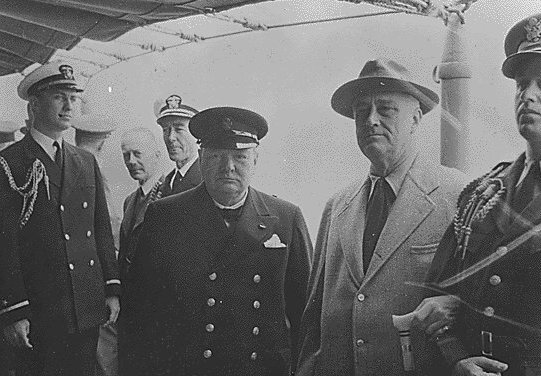
    Roosevelt and Churchill aboard the U.S. S. Augusta, off the coast of Newfoundland, August 1941

    Also on UK level the political approach towards the EU and its institutions has changed with the political personal in charge, intergovernmental relations and constellations; it is true especially in regard of the UK that the lines of approval and rejection of the EU are not congruent with party loyalities. t is therefore the task of this paper to distil ideological determinants and mind-sets and the crucial phases in British policies towards the European Union after World War II. Focus in part one lies on Britishness and its surrounding ideological patterns; part two at its core examines the last three governments of the United Kingdom, that is the administrations of Margaret Thatcher, John Major and Tony Blair.

    It will be one of the statements of this work that both of the subsequent governments in many respects can be seen in the tradition of the first mentioned, although it was then indicated in another way and hoped by many pro-Europeans that this would not be the case. Furthermore one aim will be to isolate a tendency that enables the percipients of this academic work to venture an outlook on the future relations between Europe and the UK, which is especially vital in regard of the sustainability of the Union: It has now enlarged to 27 members with some more countries in the waiting loop and its constitution is still on hold. It must be emphasized that the UK is a major player in European politics and by no means just a by-stander.

    2
    Table of Contents
    1
    General Introduction………………………………………………………………………………………………….. 3
    1.1
    Introduction and approach of this paper………………………………………………………….. 3
    2
    Britishness …………………………………………………………………………………………………………………….. 4
    2.1
    Cultural identity…………………………………………………………………………………………….. 4
    2.2
    Britain and the EMU ……………………………………………………………………………………… 5
    2.3
    Britain and the European Constitution ……………………………………………………………. 6
    3
    Special Relationship………………………………………………………………………………………………….. 7
    4
    The Euro-sceptic Press in Great Britain …………………………………………………………. 10
    5
    The „Awkward Partner“ enters the union ……………………………………………………….. 12
    6
    Margaret Thatcher: Alone against the Superstate ……………………………………………. 15
    6.1
    Margaret Thatcher and the BBQ ……………………………………………………………………. 15
    6.2
    The Late 1980s ­ Struggle Over Europe …………………………………………………………….. 17
    7
    John Major: A phase of transition …………………………………………………………………………………………………………………… 18
    8
    New Labour: Old Wine in New Bottles? …………………………………………………………………………………………………………………… 21
    8.1
    Hopes for a pro-European approach………………………………………………………………. 21
    8.2
    New Labour and the Euro…………………………………………………………………………….. 22
    9
    Evaluation and outlook………………………………………………………………………………………………………… 24
    10
    Works Cited…………………………………………………………………………………………………………….26

    To support the above-mentioned

    tendency this paper will repeatedly recur on figures of surveys among the UK’s people and

    Seite 5

    4
    examine if Euroscepticism was shared on both levels, in the governments and in the population or if classical patterns of bottom up or top down politics can be established. As Julie Smith and Mariana Tsatsas in their work The New Bilateralism point out,
    there are many factors that determine bilateral relations (5). This term paper is incorporating the points that are important in the examination of the topic; it names the treaties that shape
    the European interactions on a transnational level and provides the necessary terminology in the respective historical contexts. It is however also determined to not neglect the relations
    between the people who govern the countries; it is thus not only party platforms, bi- and multilateral treaties and assumed political alliances within the political left/right pattern that
    shape European relations, but also the chemistry between the leaders: „…good personal relations are extremely important in building effective bilateral relations between states
    (Smith/Tsatsas 7).
    These relations often do not adjust to political affiliations; for example although Tony Blair was usually associated with a „catch-all“ politics slightly tending to the left, however
    with the former conservative Prime Minister of Spain, Jose Maria Aznar, he got warmer than with many of „his fellow European Social Democrats“ (Smith/Tsatsas 31). Margaret Thatcher
    however could not conceal her disliking for her conservative counterpart in Germany: „she thought (Helmut) Kohl boring, clumsy and provincial…: „My God, that man is so German“
    (Campbell 304). It has become common to declare Margaret Thatcher the greatest anti-European in British history after WWII – it is however necessary to take a look back into the early years of the community to understand that also the Iron Lady’s policies were in some measure in line with those of her predecessors.
    2 Britishness
    2.1 Cultural identity
    Britain’s sense of itself is a strongly encouraged self-perception by its imperial past and its geographical and linguistic isolation of the rest of Europe. As in most western democracies, a strong sense of cultural identity and a concept of what Britain means is deeply rooted in Great Britain. Here Robbins offers a traditional view of cultural identification:“ identification is constructed on the back of a recognition of some common origin or shared characteristic with
    another person or group, or with an ideal, and with a natural closure of solidarity and allegiance established on this foundation“ (Robbins 282). Thus there are two factors: identification – here clearly seen as a construct – is based on either some common origin
    and/or shared characteristics; this could be historical events from the shared imperial past or, as stated above, the geographical and linguistic isolation from continental Europe.
    The second and most likely more vital factor stated by Robbins is „the natural closure of solidarity“. This concept of closure is strongly associated with the topic of cultural/group identity by many
    socialists. It describes the unconscious intention of a specific social group to not only form this group for reasons of shared origins and characteristics, but to then defend it and its perceived status from an external threat. This external threat is often referred to as „the
    Other“, which shows that it can appear in various forms and always starts as an imagined or at least perceived threat, long before it can be grasped and named factually. In the beginning the only thing that the specific social group might be certain of, is that there is a difference between their supposedly homogenous group and the external other. The manifestation of this difference rapidly turns „the Other“ into an external threat against which the shared traditions and values of the group have to be defended. Thus according to contemporary social theory, it could be plausibly argued, that one element at least of recent expressions of Euro-scepticism in Britain „stems from the presence of and perceived threat from an external „Other“, namely continental Europe“ (Robbins 285).
    Continue readin on hausarbeiten.de or contact me
  • Living in Dsytopa? Digital (non-) places in postmodern films and in the internet

    term paper abstract, Wintersemester 2006/2007, Potsdam University by Lars Dittmer

    online gaming has become a standard feature of most games that are put on the market. As a result, online communities and new „social relations“ – the phrase is put in quotation marks with a clear intent here – are established on a permanent basis in these realms with after-effects that seem to be barely controllable by the societies. The people who participate in such games, mostly boys and men between 13 and 25, are confronted with a completely new type of social pressure – online obligations. They are grouped in online „guilds“ that meet and play at certain times of the day, there are special events in which they are expected to join, and if they are not investing a certain span of time daily into their online-characters – which need to be advanced – they are outdone by other guilds or members of their own groups.

    Indeed they are spending days of their lives in these realms, which allows for the statement that these places have become anthropospheres, spaces that are filled with human life and everything it entails. The potential to lose contact with real life (rl as it is called among players) is massive. Early the culture industry has been fascinated with living in alternative or simulated realities and its „perpetual oscillation between utopia and dystopia“ (Durham 5). Many visions, as I shall point out in this term paper, presage today’s developments to an astonishing degree – sure enough the ones I deal with are rather dystopian. Notably, the most prominent in recent years has been the 1999 film „Matrix“ by the Wachowski brothers, which has been extended to a trilogy. Also science has come up with certain models that can be employed to conceptualize these spaces – I will outline some of these and try to put them in the context that serves my problem.

    It is, in my view, necessary to view today’s colonisation of and living in these spaces that I have outlined above and will further detail in the course of this paper, in front of a background of media production of the period since WWII. The idea that informs this undertaking is, that there have been numerous accounts who predict what is being made accessible to computer users at the moment – Cyberspace is no longer a room that can be inhabited in the future, but it is right now open to everyone; the Cyborg has come into existence.

    Table of Contents

    1. Introduction and problem identification. 3

    2. approach of this term paper 6

    3. Welt am Draht and its derivates. 7

    4. Stephen Lisbergers „Tron“. 10

    5.  Peter Weirs „The Truman Show“. 12

    6. Early cyberspaces and their spatiality. 14

    7. Entering cyberspaces by avatars. 16

    8. Structures in cyberspaces – non-places or simulacra. 19

    9. Power in imaginary spaces. 22

    10. Second Life et alie: my personal Dystopia?. 24

    Works Cited. 27

    1. Introduction and problem identification

    After a relatively noiseless online-launch in 2003, the computer Game Second Life has seen an incredible increase in users within the last few months and therefore has attracted the attention of international media. The game provides for an online-world in which numerous activities –chatting, flirting, shopping etc. are being made possible to the users. The players take part in the form of  avatars, pixel-figures that can be created and designed according to the wishes of the members.

    While in October 2006 the one millionth avatar has seen the light of the virtual world, by now (early April 2007) more than 5 million users roam the places and spaces of the alternative realm of Second Life. The idea behind the game is by no means new and merely marks the latest step in a development that can be traced back to early primitive computer games like flight and sports simulators.

    Whereas in most simulation games however only parts of „reality“ where isolated and converted into programs that were mostly played alone, in the late 1990s and the early years of the first decade after 2000 a whole new generation of games flooded the shelves of the games retailers which came as a result of spreading fast broadband internet connections and the possibility of real-time chatting. In Massive Multiplayer Online (Role-Playing) Games (MMO(RP)Gs) like World of Warcraft (WOW), in some aspects a predecessor to Second Life, a confined fantasy realm which is permanently online waits for the young players to be liberated of evil or good forces – depending on the side one aligns with.

    Here it becomes real what many authors tend to call „the end of geography“  and „the triumph of technology over space“ (Mosco 38). Heros from all countries in these games are thanks to the internet able to team up in Guilds and Clans and share „valuable“ items like swords and armours that can be found throughout these worlds and thereby improve their avatars. They are of course able to choose their identity – inter alia dwarves, humans, night elves and other races and classes can be deployed in the online-battles that are waged in the game twenty four hours a day.

    Second Life is not informed by a fantasy story like WOW –  it however addressed itself to the task to deliver its users a complete living space with a broad variety of possible actions and, what is even more important, social interactions designed to attract more and more users. Both games – Second Life will be dealt with in detail later in this term paper – are just the most successful top of the iceberg; online gaming has become a standard feature of most games that are put on the market. As a result, online communities  and new „social relations“ – the phrase is put in quotation marks with a clear intent here – are established on a permanent basis in these realms with after-effects that seem to be barely controllable by the societies.

    The people who participate in such games, mostly boys and men between 13 and 25, are confronted with a completely new type of social pressure – online obligations. They are grouped in online „guilds“ that meet and play at certain times of the day, there are special events in which they are expected to join, and if they are not investing a certain span of time daily into their online-characters – which need to be advanced – they are outdone by other guilds or members of their own groups.  Indeed they are spending days of their lives in these realms, which allows for the statement that these places have become anthropospheres, spaces that are filled with human life and everything it entails.  The potential to lose contact with real life (rl as it is called among players) is massive; China has due the rising amount of highly addicted young players reduced the runtime of the servers, there have been even reports about deaths in front of the screen due to dehydration and lack of nutrition (Wikipedia, the free Encyclopaedia). If actually true, online worlds are not only places to live, but also to die.

    Continue reading on Hausarbeiten.de

  • Studio 54: Admission policies as a form of individualism in New York seventies’ most famous disco and its display in film and literature

    term paper abstract, Winter Semester 2005/2006, Potsdam University by Lars Dittmer

    „…and for three years it was the most talked-about, written-about and shocked-about venue in the universe. Everyone wanted to go to Studio 54 (Jones/ Kantonen 1999: 246)”. “A lot of people thought that at the door was a better show than inside…people would try anything to get in (“Shane” in Studio 54)”. When Steve Rubell and Ian Schrager in the late April 1976 started their nightclub Studio 54, a legend came to life. On the floors of this unique party shangri-la, celebrities like Andy Warhol, Liza Minelli, Bianca and Mick Jagger, Brooke Shields and Truman Capote mingled with business people, politicians, soap opera starlets, drag queens and chosen few from the “grey people”, as nightlife guru Rubell called the normal people.

    Never before, a discothèque had caused such a public stir. Paparazzi jostled beyond the velvet ropes to illustrate their gossip columns with pictures of the socialites – it was the “first time ever that celebrity photos would appear on the front page of the tabloids for no other reasons than they were there (Jones/ Kantonen 1999: 249)”. But by far not everybody came to know the true promise of the club – door policy at Studio 54 was probably one of the toughest in the history of nightlife. Rubell himself was eager to make sure that of the many different groups that made up the audience of 54, none should dominate the other, a type of “social engineering he called “tossing the salad”” (Shapiro 2005: 201). He himself supported his doorman Marc Benecke selecting the people who could pass the velvet ropes, whilst scores of people shouted Rubell’s name begging him to be admitted into the club. On one hand, there were certain criteria, but on the other hand, there was enough leeway for arbitrariness, indeed, it was a highly undemocratic procedure that precisely reflected its place, its period and social circumstances.

    Disco in the ‚uncanny 1970s‘ not only served to escape reality but also epitomised an increasing drive towards individualism that replaced the ideas of participation and community of the sixties. The doors at 54 were instruments to form a new world with new social ladders and in their radicalism marked a peak in this development.

    Table of Contents

    1. General Introduction 3

    1.1 Introduction and problem identification
    1.2 Approach of this term paper

    2. The Seventies – need to escape? 5

    2.1 The faceless decade
    2.2 The economic downturn – stagflation and unemployment
    2.3 Repercussions of Vietnam

    3. Disco – feared and sneered at 9

    3.1 Countercultural phenomenon or foofaraw?
    3.2 Home of the Disenfranchised

    4. Studio 54 – Queen of Manhattan 12

    4.1 Steve Rubell, Ian Schrager and their dream
    4.2 Drug supply at 54

    5. Escaping the “grey people”: door policy at Studio 54 14

    5.1 The “right mix”
    5.2 Tossing the salad
    5.3 The inner-sanctum

    6. Conclusion 18

    7. Bibliography 20

    1. General Introduction

    1.1 Introduction and problem identification

    „…and for three years it was the most talked-about, written-about and shocked-about venue in the universe. Everyone wanted to go to Studio 54 (Jones/ Kantonen 1999: 246)”.

    “A lot of people thought that at the door was a better show than inside…people would try anything to get in (“Shane” in Studio 54)”.

    When Steve Rubell and Ian Schrager in the late April 1976 started their nightclub Studio 54, a legend came to life. On the floors of this unique party shangri-la, celebrities like Andy Warhol, Liza Minelli, Bianca and Mick Jagger, Brooke Shields and Truman Capote mingled with business people, politicians, soap opera starlets, drag queens and chosen few from the “grey people”, as nightlife guru Rubell called the normal people. Never before, a discothèque caused such a public stir. Paparazzi jostled beyond the velvet ropes to illustrate their gossip columns with pictures of the socialites – it was the “first time ever that celebrity photos would appear on the front page of the tabloids for no other reasons than they were there (Jones/ Kantonen 1999: 249)”.

    The place for this unprecedented spectacle was 254 West 54th street in Manhattan, New York. As to grandeur and pomp, Studio 54 easily dwarfed all other night clubs, the interior was lavish in every respect, the decor sometimes changed from weak to weak. Besides alcohol, drug abuse was rampant – be it cocaine or MDA, Rubell and his team left nothing to be desired for Studio 54’s fastidious clientele. Disc Jockey Richard Kaczor, “who by 1979 was earning $50,000 a year and thus was the world’s highest-paid DJ (Shapiro 2005: 204), was a luminary in his field. But the frenzy was not about technical details or size of the club, not even about the latest in music – it was about seeing and being seen on the highest level conceivable.

    By far not everybody came to know the true promise of the club – door policy at Studio 54 was probably one of the toughest in the history of nightlife. Rubell himself was eager to make sure that of the many different groups that made up the audience of 54, none should dominate the other, a type of “social engineering he called “tossing the salad”” (Shapiro 2005: 201). He himself supported his doorman Marc Benecke selecting the people who could pass the velvet ropes, whilst scores of people shouted Rubell’s name begging him to be admitted into the club. On one hand, there were certain criteria, but on the other hand, there was enough leeway for arbitrariness, indeed, it was a highly undemocratic procedure that precisely reflected its place, its period and social circumstances.

    Scholars often describe the Seventies in the United States as a dreary, unsteady and uncanny period – a decade that has started with the trials and tribulations of Vietnam War, continued with the Watergate scandal and experienced the first post World War II economic downturn with skyrocketing unemployment rates, stagflation and a melting welfare state. Repercussions of these events were especially felt in New York City of these days, which Peter Shapiro reports, was felt by many to be a “cesspool of moral and spiritual degradation, a playground for drug dealers, pimps and corrupt cops (2005: x)”. Disco in this time not only served to escape reality but also epitomised an increasing drive towards individualism that replaced the ideas of participation and community of the sixties. The doors at 54 were instruments to form a new world with new social ladders and in their radicalism marked a peak in this development.

    1.2 Approach of this term paper

    This term paper wants to examine the new hierarchies that were established at Studio 54, especially at its front doors in the late Seventies and examines the cultural and historical context that determines this phenomenon. The paper evolves around two poles: Disco, which is treated herein as a trend towards escapism, hedonism and individualism with Studio 54 as its most extreme excrescence, and the United States, which in the Seventies delivered a setting with most attributes of a deteriorating industrialised country and New York as a city in which these attributes culminated. Disco herein is a term that labels a style of dance music as well as the movement with all its fashions and conventions. The distinction made between the two concepts will be clear from the respective context it is used in.

    In order to manifest the above-mentioned society internal drive towards individualism the second point of this paper deals with the Seventies as the decade that enabled the success-story of disco. The pictures this paper delivers about the decade are not pleasant but it has to be considered that history is a concept that in its broadness is impossible to capture. Personal remembrances of the decade might vary from person to person. This paper therefore delivers texts of scholarly assessments and commonly-acknowledged views of the Seventies as a decade, trying to explain what triggered the public desire to escape reality and the sense of hedonism and decadence that characterised disco.

    Continue reading on Hausarbeiten.de or contact me

  • At a Loss: The Postmodern Quests in Thomas Pynchon’s „The Crying of Lot 49“ and Jim Jarmusch’s „Broken Flowers“

    term paper abstract, summer semester 2006, Potsdam university by Lars Dittmer

    this paper is building up on postmodern patterns of fragmentation, loneliness and disorientation. The Quest is a central storytelling technique – in times where traditional ways of living and social constellations fade and the grand narratives have lost their guiding functions, people have to „mind-map“ their own routes through a fagmentary world. The paper establishes the quest form in the 1966 book by Pynchon and draws lines of tradition to Jarmusch’s 2005 Browken Flowers.


    Table of Contents

    1. General Introduction  3

    1.1 Overview: The two stories  3

    1.2 Approach of this term paper  5

    1.3 From modernism to postmodernism  7

    2. Social fragmentation as a postmodern determinant  8

    2.1 Oedipa Maas: “They are stripping away, my men”  8

    2.2 Don Johnston a.k.a. Don Juan  10

    2.3 Drugs and unreliability  11

    3. To slow for a globalizing/ globalized world?  2

    3.1 Miss Maas and Mass Media  12

    3.2 “I was in computers”   13

    3.3. The United States as a setting  14

    4. Me against the system: anxieties and paranoia  16

    4.1 mind-mapping against the machine  16

    4.2 The non-solution to nothing  18

    5. Conclusion: Internet and Postmodernity  19

    6. Bibliography  20

    1. General Introduction

    „Hey”, said Oedipa, “can I get somebody to do it for me?”

    “Me”, said Roseman, “some of it, sure. But aren’t you even interested?”

    In what?”

    “In what you might find out.” (Pynchon 1966: 12)

    “I prepared the strategy. Only you can solve the mystery” (Winston in Broken Flowers).

    1.2 Overview: the two stories

    There is hardly a novel that outlines a cultural epoch as precisely as the 1966 published book “The Crying of Lot 49” (COL 49) by Thomas Pynchon. On barely more than one hundred pages probably every concept that has ever attributed to the set of ideas we today refer to as “postmodern”, can be identified. The book, that many describe as one of the most important post World War II novels, is a challenge in every respect: Pynchon’s dense and intricate style of writing with its often loose and disconnected sequences leave many readers baffled – what on the first glance seems a humorous and easy read on the second requires profound knowledge of American and European history and sketches a sometimes bleak and dreary picture of human isolation and paranoia. Nevertheless connoisseurs describe “The Crying of Lot 49” as his most accessible book.

    Thomas Pynchon as a person remains as mysterious as his novels – the fact that he never appears in public and discusses his books, leaves literary theorists room for interpretation and speculation. This is reflected in literature about Pynchon – there is hardly a self-respecting scholar of 20th century American literature that has not elaborated on his work: “Pynchon’s novels have lured literary theorists and critics to such an extent that they have spawned an industry” (Coale 2005: 135). But also to other artists he is a constant source of inspiration – as we will see, not only to writers like Paul Auster, Don DeLillo or Susan Sontag, but also to movie artists. Filmmakers like David Lynch, Quentin Tarantino or last but not least Jim Jarmusch constantly process postmodern elements and sujets – what started as “independent cinema” has – thanks to blockbusters like “Kill Bill”, “Jackie Brown” or “Mulholland Drive” – gradually entered the mainstream and is now being received by major audiences.

    But though postmodern elements in these movies can be isolated and discussed – sure enough, literature has dealt with most of them – a direct comparison with “The Crying of Lot 49”, one of the archetyps of postmodernism, would be barely fruitful, as the latter’s appearance equals a mystery novel. However, the 2005 Jim Jarmusch production Broken Flowers, starring Bill Murray, is arranged following a “Pynchonesque” quest pattern and can be therefore directly placed in this context; there are obvious parallels as to structure, story and background setting between the two pieces.  To discuss the elements that qualify Broken Flowers as a movie in this tradition will be the task of this term paper.

    At first it is necessary to deliver short synopsises of the two stories – many of the elements will be dealt with in-depth in the course of this term paper. The protagonist in COL 49, Oedipa Maas, “a suburban housewife and English major from Cornell” (Cornis-Pope 2001: 104), receives a letter saying that her ex Pierce Inverarity died and that she “had been named executor, or she supposed executrix,” (Pynchon 1966: 5) of his estate. She accepts the challenge that takes her “from her suburbanite home in Kinneret-among the Pines to the Echo Courts Motel in San Narciso, the housing estate at Fangoso Lagoons, the aerospace company Yoyodyne, the Berkeley campus, and the Greek Way bar in San Francisco. (Cornis-Pope 2001: 105).

    Continue on Hausarbeiten.de or contact me

  • Are the parties in the United States still vehicles for environmental politics? How do they occupy this political field, and what ideological and sociological aspects affect this process?

    term paper abstract, summer semester 2005, Potsdam university by Lars Dittmer

    „There is nothing so American as our national parks. The scenery and wildlife are native. The fundamental idea behind the parks is native. The parks stand as an outward symbol of this great human principle”. These sentences are not extracted from the platform of the American Green Party – they are from a quote of Franklin Delano Roosevelt, the 32nd President of the United States, a Republican. In his thinking, “conservation was closely tied to American Values” (Sussman/ Daynes/ West 2001: 169). During his governing period, environmental care was directly incorporated in governmental action – various agencies and bureaucracies were established to deal with this topic.

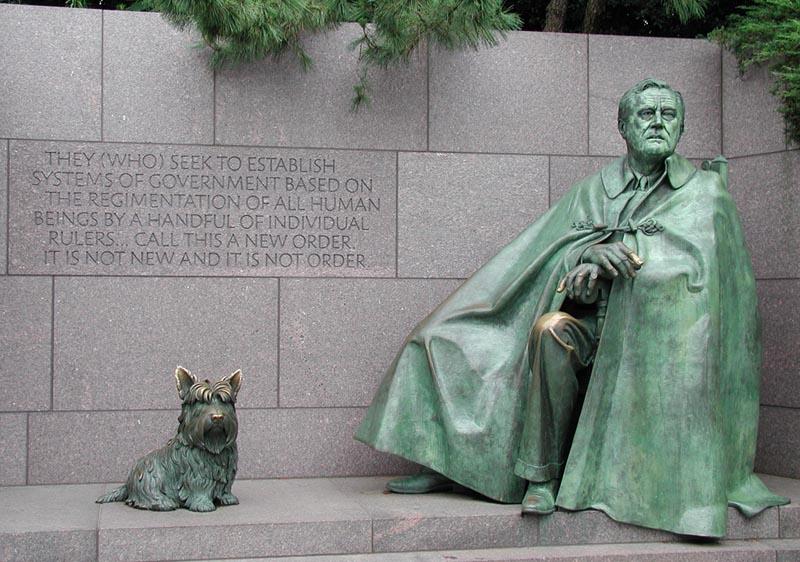
    FDR memorial in Washington with dog Fala
    FDR memorial in Washington with dog Fala

    Today, the United States reject major international environmental treaties such as the Kyoto Protocol, requiring participants to reduce green house gases below the 1990 level by 2012. The Bush administration has presented plans to drill for oil in the Arctic National Wildlife Refuge, a swathe of land in northeast Alaska, populated by migratory birds, wolves and caribou. The House of Representatives had already approved these plans, the Senate rejected them. In voting George W. Bush their 43rd President, a majority of the American people made their cross for a candidate with a green record tending to zero. But not only does environmental policy seem to have left the political agenda on a larger scale, observers more and more get the impression that the American people seem to care lesser for environmental aspects than ten or twenty years ago – only considering, among many other factors, the increasing number of polluting light trucks and SUVs on American roads.

    So can we conclude that, considering the fact that the parties fight for the support of the American mainstream, both Democrats and Republicans have banned environmental politics from their platforms? This paper is to figure out to what extent the field of environmental policy still is a factor in the American political landscape and what ideological and sociological factors are at play in this process and in the party-internal treatment of the topic.

    Table of Contents

    1. General Introduction

    1.1 Introduction and problem identification
    1.2 Approach of this term paper

    2. Environmental policy in the American discourse

    2.1 Ideological determinants
    2.2 Areas of Tension

    2.2.1 Economic efficiency vs. Ecology
    2.2.2 Sociogeographical variances

    2.2.2.1 Traditional labour versus modern production
    2.2.2.2 Translation into politics

    3. Parties and Positioning in the field

    3.1 Republicans: home for anti-environmentalists
    3.2 A “green” voting record in Congress: the Democrats
    3.3 The Green Party and environmental organizations

    4. Historical Perspective: Presidential performance

    4.1 “The Green Decade”
    4.2 The Eighties: Reagan and Bush
    4.3 Clinton and the 104th Congress

    5. Conclusion and outlook

    6. Bibliography

    I. General Introduction

    1.1 Introduction and problem identification

    „There is nothing so American as our national parks. The scenery and wildlife are native. The fundamental idea behind the parks is native. The parks stand as an outward symbol of this great human principle”. These sentences are not extracted from the platform of the American Green Party – they are from a quote of Franklin Delano Roosevelt, the 32nd President of the United States. In his thinking, “conservation was closely tied to American Values” (Sussman/ Daynes/ West 2001: 169). During his governing period, environmental care was directly incorporated in governmental action – various agencies and bureaucracies were established to deal with this topic. Today, the United States rejects major international environmental treaties such as the Kyoto Protocol, requiring signatories to reduce green house gases below the 1990 level by 2012. The Bush administration has presented plans to drill for oil in the Arctic National Wildlife Refuge, a swathe of land in northeast Alaska populated by migratory birds, wolves and caribou. The House of Representatives had already approved these plans, the Senate rejected them. In voting George W. Bush their 43rd President, a majority of the American people made their cross for a candidate with a green record tending to zero.

    But not only does environmental policy seem to have left the political agenda on a larger scale, observers are increasingly getting the impression that the American people seem to care less for environmental aspects than ten or twenty years ago – only considering, among many other factors, the increasing number of polluting light trucks and SUVs on American roads. So can we conclude that, considering the fact that the parties fight for the support of the American mainstream, both Democrats and Republicans have banned environmental politics from their platforms? Indeed, it is the needs of American public that party platforms should address, as a part of the identification of a problem or issue of salience and the formulation of a policy. If such a tendency becomes obvious, do the parties react in that way?

    1.2 Approach of this term paper

    This term paper is to figure out to what extent the field of environmental policy still is a factor in the American political landscape – putting special focus on the political parties. It is not concentrating on the various aspects of which environmental policy constitute, such as air and water preservation, energy politics and consumer protection, but it will make the differentiation if a certain issue requires it. In fact, environmental policy herein is treated only as a political subject, focussing on which party concentrated on it, when, to what degree, and what ideological and socio logical factors are at play in this process and in the internal party treatment of the topic. It starts with an attempt to elaborate a scheme of various areas of tension that are inherent in environmental politics in the United States, then it continues deducing how the parties fit within this texture. In the final part the paper takes a look in history, trying to find out if the scheme established in the middle part is confirmed by how the parties actually occupied this political area in the past and what their role was.

    2. Environmental politics in the American discourse

    2.1 Ideological determinants

    In comparison to most of the European countries, taking into consideration values and attitudes of the United States, the constellation of the political parties in the congress and the voting behaviour of the citizens, the United States can be called a conservative country. Socialism has been almost eradicated from the political map – only some left wing Democrats or small splinter parties nobody takes seriously still fancy with socialist ideas. Values like patriotism, family and religiousness have become mainstream attitude in the States – “moral values” for most Americans were the motivation to elect George W. Bush their President, who previously had been known as a Republican hardliner from Texas. “The environment is an issue without any obvious political home” John E. Bliese quotes Frances Cairncross of the Economist (2001: 10) – indeed, a statement from a theoretical point of view. However, in the environmental discussion in the USA, often sociological and ideological aspects are mingled into the debate. In the heads of most Americans, environment has a political home – it is a topic of quixotic anticapitalists, socialists and intellectuals. It has become mainstream thinking that somebody who cares for trees or animals has no idea of the problems of ordinary people.

    […]

    Continue reading on Hausarbeiten.de or contact me

  • Development and Demise of Orkney Norn – a peace of Scandinavian Culture in Great Britain

    term paper abstract, winter semester 2004/2005, Potsdam university by Lars Dittmer

    the Nordic cross in Great Britain – the unofficial flag of the Orkney Islands arouses astonishment in the watcher and gives him an idea of how Orcadians feel – being a Scandinavian, and being British. The flag shows the red Norwegian cross on a yellow background, symbolizing the Scottish Royal flag (cf. Towrie 1996-2005: FAQ). Scandinavian culture and self-image still constitute a part of identity in parts of Scotland – especially in Shetland and Orkney, collectively named the Northern Islands. Here, this cultural background has over centuries found expression through a Scandinavian language, called Norn, Icelandic norœnna, the Norwegian language (Fenton 1997: 617).

    former flag of Orkey - Scandinavian and British at the same time

    This term paper is to document the historical and cultural circumstances in which a Scandinavian language could develop in Northern Scotland, its nature and prevalence during its era, and finally, its demise and the remains of Norn in today’s language in Orkney. The paper attaches importance to the fact that it is on the one hand power constellations and politics that produce linguistic changes such as the death of a language, but on the other hand also requires “the active participation of its former speakers” (Barrett 2003: 98). The paper almost exclusively focuses on the development on the Orkney Islands, taking into consideration that history as well as the language itself differs to some extent on the Shetland Islands.

    Development and Demise of Orkney Norn – a peace of
    Scandinavian Culture in Great Britain

    Table of Contents

    1. General Introduction

    1.1 Introduction: the Nordic cross in Great Britain
    1.2 General facts about Orkney

    2. History and Language

    2.1 Pre-Norse Orkney
    2.2 The Pictish-Norse transition
    2.3 The Vikings and their language
    2.4 Norn
    2.5 “Scottization” – the demise of Orkney Norn

    3. Language in Orkney today

    3.1 The remnants of Norn
    3.2 The Orcadian dialect
    3.3 discussion/ outlook

    4. Bibilography

    1. General Introduction

    1.1. Introduction: the Nordic cross in Great Britain

    The unofficial flag of the Orkney Islands arouses astonishment in the watcher and gives him an idea of how Orcadians feel – being a Scandinavian, and being British. The flag shows the red Norwegian cross on a yellow background, symbolizing the Scottish Royal flag (cf. Towrie 1996-2005: FAQ). Scandinavian culture and self- image still constitute a part of identity in parts of Scotland – especially in Shetland and Orkney, collectively named the Northern Islands. Here, this cultural background has over centuries found expression through a Scandinavian language, called Norn, Icelandic nor(?)nna, the Norwegian language (Fenton 1997: 617).

    This term paper is to document the historical and cultural circumstances in which a Scandinavian language could develop in Northern Scotland, its nature and prevalence during its era, and finally, its demise and the remains of Norn in today’s language in Orkney. The paper attaches importance to the fact that it is on the one hand power constellations and politics that produce linguistic changes such as the death of a language, but on the other hand also requires “the active participation of its former speakers” (Barrett 2003: 98). The paper almost exclusively focuses on the development on the Orkney Islands, taking into consideration that history as well as the language itself differs to some extent on the Shetland Islands.

    1.2 General facts about Orkney

    Orkney1 is an archipelago of about 70 islands lying ten kilometres off the north coast of Scotland in the North Sea. The 2001 census provided a total number of 19, 245 people inhabiting less than one third of the islands. The major part of the population lives in the two main towns Kirkwall, the administrative centre of Orkney, and Stromness, both being located on “Mainland”, the largest island of the archipelago. Of further importance are the islands Hoy and South Ronaldsay in the south of Scapa Flow, and some minor islands in the north such as Sanday or Westray. People are mainly employed in agriculture and tourism. Since the 1970s, North Sea oil contributes to the income of the Orcadians. Since the 1990s, however, flows from this industry have decreased (Leyden 2004: 11).

    2. History and language

    2.1 Pre-Norse Orkney

    Today, there is no exact knowledge about the question when first human life came to Orkney. Nevertheless, there is evidence that the islands have provided human habitat for at least five and a half thousand years (Ritchie 1990: 36). Preserved constructions from these days such as the Ring of Brodgar, a large stone circle, and Maes Howe, a chambered tomb on Mainland, show that people in the Neolithic era were skilful stone-builders (Ritchie 1990: 39). Identity and language of the Picts, a tribe that settled in mainland Scotland and the Northern Islands from around 300 BC to the Norse settlements, have remained subject to dispute until today.

    (…)

    Continue reading on Hausarbeiten.de or contact me