Schlagwort: USA

  • Studio 54: Admission policies as a form of individualism in New York seventies’ most famous disco and its display in film and literature

    term paper abstract, Winter Semester 2005/2006, Potsdam University by Lars Dittmer

    „…and for three years it was the most talked-about, written-about and shocked-about venue in the universe. Everyone wanted to go to Studio 54 (Jones/ Kantonen 1999: 246)”. “A lot of people thought that at the door was a better show than inside…people would try anything to get in (“Shane” in Studio 54)”. When Steve Rubell and Ian Schrager in the late April 1976 started their nightclub Studio 54, a legend came to life. On the floors of this unique party shangri-la, celebrities like Andy Warhol, Liza Minelli, Bianca and Mick Jagger, Brooke Shields and Truman Capote mingled with business people, politicians, soap opera starlets, drag queens and chosen few from the “grey people”, as nightlife guru Rubell called the normal people.

    Never before, a discothèque had caused such a public stir. Paparazzi jostled beyond the velvet ropes to illustrate their gossip columns with pictures of the socialites – it was the “first time ever that celebrity photos would appear on the front page of the tabloids for no other reasons than they were there (Jones/ Kantonen 1999: 249)”. But by far not everybody came to know the true promise of the club – door policy at Studio 54 was probably one of the toughest in the history of nightlife. Rubell himself was eager to make sure that of the many different groups that made up the audience of 54, none should dominate the other, a type of “social engineering he called “tossing the salad”” (Shapiro 2005: 201). He himself supported his doorman Marc Benecke selecting the people who could pass the velvet ropes, whilst scores of people shouted Rubell’s name begging him to be admitted into the club. On one hand, there were certain criteria, but on the other hand, there was enough leeway for arbitrariness, indeed, it was a highly undemocratic procedure that precisely reflected its place, its period and social circumstances.

    Disco in the ‚uncanny 1970s‘ not only served to escape reality but also epitomised an increasing drive towards individualism that replaced the ideas of participation and community of the sixties. The doors at 54 were instruments to form a new world with new social ladders and in their radicalism marked a peak in this development.

    Table of Contents

    1. General Introduction 3

    1.1 Introduction and problem identification
    1.2 Approach of this term paper

    2. The Seventies – need to escape? 5

    2.1 The faceless decade
    2.2 The economic downturn – stagflation and unemployment
    2.3 Repercussions of Vietnam

    3. Disco – feared and sneered at 9

    3.1 Countercultural phenomenon or foofaraw?
    3.2 Home of the Disenfranchised

    4. Studio 54 – Queen of Manhattan 12

    4.1 Steve Rubell, Ian Schrager and their dream
    4.2 Drug supply at 54

    5. Escaping the “grey people”: door policy at Studio 54 14

    5.1 The “right mix”
    5.2 Tossing the salad
    5.3 The inner-sanctum

    6. Conclusion 18

    7. Bibliography 20

    1. General Introduction

    1.1 Introduction and problem identification

    „…and for three years it was the most talked-about, written-about and shocked-about venue in the universe. Everyone wanted to go to Studio 54 (Jones/ Kantonen 1999: 246)”.

    “A lot of people thought that at the door was a better show than inside…people would try anything to get in (“Shane” in Studio 54)”.

    When Steve Rubell and Ian Schrager in the late April 1976 started their nightclub Studio 54, a legend came to life. On the floors of this unique party shangri-la, celebrities like Andy Warhol, Liza Minelli, Bianca and Mick Jagger, Brooke Shields and Truman Capote mingled with business people, politicians, soap opera starlets, drag queens and chosen few from the “grey people”, as nightlife guru Rubell called the normal people. Never before, a discothèque caused such a public stir. Paparazzi jostled beyond the velvet ropes to illustrate their gossip columns with pictures of the socialites – it was the “first time ever that celebrity photos would appear on the front page of the tabloids for no other reasons than they were there (Jones/ Kantonen 1999: 249)”.

    The place for this unprecedented spectacle was 254 West 54th street in Manhattan, New York. As to grandeur and pomp, Studio 54 easily dwarfed all other night clubs, the interior was lavish in every respect, the decor sometimes changed from weak to weak. Besides alcohol, drug abuse was rampant – be it cocaine or MDA, Rubell and his team left nothing to be desired for Studio 54’s fastidious clientele. Disc Jockey Richard Kaczor, “who by 1979 was earning $50,000 a year and thus was the world’s highest-paid DJ (Shapiro 2005: 204), was a luminary in his field. But the frenzy was not about technical details or size of the club, not even about the latest in music – it was about seeing and being seen on the highest level conceivable.

    By far not everybody came to know the true promise of the club – door policy at Studio 54 was probably one of the toughest in the history of nightlife. Rubell himself was eager to make sure that of the many different groups that made up the audience of 54, none should dominate the other, a type of “social engineering he called “tossing the salad”” (Shapiro 2005: 201). He himself supported his doorman Marc Benecke selecting the people who could pass the velvet ropes, whilst scores of people shouted Rubell’s name begging him to be admitted into the club. On one hand, there were certain criteria, but on the other hand, there was enough leeway for arbitrariness, indeed, it was a highly undemocratic procedure that precisely reflected its place, its period and social circumstances.

    Scholars often describe the Seventies in the United States as a dreary, unsteady and uncanny period – a decade that has started with the trials and tribulations of Vietnam War, continued with the Watergate scandal and experienced the first post World War II economic downturn with skyrocketing unemployment rates, stagflation and a melting welfare state. Repercussions of these events were especially felt in New York City of these days, which Peter Shapiro reports, was felt by many to be a “cesspool of moral and spiritual degradation, a playground for drug dealers, pimps and corrupt cops (2005: x)”. Disco in this time not only served to escape reality but also epitomised an increasing drive towards individualism that replaced the ideas of participation and community of the sixties. The doors at 54 were instruments to form a new world with new social ladders and in their radicalism marked a peak in this development.

    1.2 Approach of this term paper

    This term paper wants to examine the new hierarchies that were established at Studio 54, especially at its front doors in the late Seventies and examines the cultural and historical context that determines this phenomenon. The paper evolves around two poles: Disco, which is treated herein as a trend towards escapism, hedonism and individualism with Studio 54 as its most extreme excrescence, and the United States, which in the Seventies delivered a setting with most attributes of a deteriorating industrialised country and New York as a city in which these attributes culminated. Disco herein is a term that labels a style of dance music as well as the movement with all its fashions and conventions. The distinction made between the two concepts will be clear from the respective context it is used in.

    In order to manifest the above-mentioned society internal drive towards individualism the second point of this paper deals with the Seventies as the decade that enabled the success-story of disco. The pictures this paper delivers about the decade are not pleasant but it has to be considered that history is a concept that in its broadness is impossible to capture. Personal remembrances of the decade might vary from person to person. This paper therefore delivers texts of scholarly assessments and commonly-acknowledged views of the Seventies as a decade, trying to explain what triggered the public desire to escape reality and the sense of hedonism and decadence that characterised disco.

    Continue reading on Hausarbeiten.de or contact me
  • At a Loss: The Postmodern Quests in Thomas Pynchon’s „The Crying of Lot 49“ and Jim Jarmusch’s „Broken Flowers“

    term paper abstract, summer semester 2006, Potsdam university by Lars Dittmer

    this paper is building up on postmodern patterns of fragmentation, loneliness and disorientation. The Quest is a central storytelling technique – in times where traditional ways of living and social constellations fade and the grand narratives have lost their guiding functions, people have to „mind-map“ their own routes through a fagmentary world. The paper establishes the quest form in the 1966 book by Pynchon and draws lines of tradition to Jarmusch’s 2005 Browken Flowers.


    Table of Contents

    1. General Introduction  3

    1.1 Overview: The two stories  3

    1.2 Approach of this term paper  5

    1.3 From modernism to postmodernism  7

    2. Social fragmentation as a postmodern determinant  8

    2.1 Oedipa Maas: “They are stripping away, my men”  8

    2.2 Don Johnston a.k.a. Don Juan  10

    2.3 Drugs and unreliability  11

    3. To slow for a globalizing/ globalized world?  2

    3.1 Miss Maas and Mass Media  12

    3.2 “I was in computers”   13

    3.3. The United States as a setting  14

    4. Me against the system: anxieties and paranoia  16

    4.1 mind-mapping against the machine  16

    4.2 The non-solution to nothing  18

    5. Conclusion: Internet and Postmodernity  19

    6. Bibliography  20

    1. General Introduction

    „Hey”, said Oedipa, “can I get somebody to do it for me?”

    “Me”, said Roseman, “some of it, sure. But aren’t you even interested?”

    In what?”

    “In what you might find out.” (Pynchon 1966: 12)

    “I prepared the strategy. Only you can solve the mystery” (Winston in Broken Flowers).

    1.2 Overview: the two stories

    There is hardly a novel that outlines a cultural epoch as precisely as the 1966 published book “The Crying of Lot 49” (COL 49) by Thomas Pynchon. On barely more than one hundred pages probably every concept that has ever attributed to the set of ideas we today refer to as “postmodern”, can be identified. The book, that many describe as one of the most important post World War II novels, is a challenge in every respect: Pynchon’s dense and intricate style of writing with its often loose and disconnected sequences leave many readers baffled – what on the first glance seems a humorous and easy read on the second requires profound knowledge of American and European history and sketches a sometimes bleak and dreary picture of human isolation and paranoia. Nevertheless connoisseurs describe “The Crying of Lot 49” as his most accessible book.

    Thomas Pynchon as a person remains as mysterious as his novels – the fact that he never appears in public and discusses his books, leaves literary theorists room for interpretation and speculation. This is reflected in literature about Pynchon – there is hardly a self-respecting scholar of 20th century American literature that has not elaborated on his work: “Pynchon’s novels have lured literary theorists and critics to such an extent that they have spawned an industry” (Coale 2005: 135). But also to other artists he is a constant source of inspiration – as we will see, not only to writers like Paul Auster, Don DeLillo or Susan Sontag, but also to movie artists. Filmmakers like David Lynch, Quentin Tarantino or last but not least Jim Jarmusch constantly process postmodern elements and sujets – what started as “independent cinema” has – thanks to blockbusters like “Kill Bill”, “Jackie Brown” or “Mulholland Drive” – gradually entered the mainstream and is now being received by major audiences.

    But though postmodern elements in these movies can be isolated and discussed – sure enough, literature has dealt with most of them – a direct comparison with “The Crying of Lot 49”, one of the archetyps of postmodernism, would be barely fruitful, as the latter’s appearance equals a mystery novel. However, the 2005 Jim Jarmusch production Broken Flowers, starring Bill Murray, is arranged following a “Pynchonesque” quest pattern and can be therefore directly placed in this context; there are obvious parallels as to structure, story and background setting between the two pieces.  To discuss the elements that qualify Broken Flowers as a movie in this tradition will be the task of this term paper.

    At first it is necessary to deliver short synopsises of the two stories – many of the elements will be dealt with in-depth in the course of this term paper. The protagonist in COL 49, Oedipa Maas, “a suburban housewife and English major from Cornell” (Cornis-Pope 2001: 104), receives a letter saying that her ex Pierce Inverarity died and that she “had been named executor, or she supposed executrix,” (Pynchon 1966: 5) of his estate. She accepts the challenge that takes her “from her suburbanite home in Kinneret-among the Pines to the Echo Courts Motel in San Narciso, the housing estate at Fangoso Lagoons, the aerospace company Yoyodyne, the Berkeley campus, and the Greek Way bar in San Francisco. (Cornis-Pope 2001: 105).

    Continue on Hausarbeiten.de or contact me

  • Are the parties in the United States still vehicles for environmental politics? How do they occupy this political field, and what ideological and sociological aspects affect this process?

    term paper abstract, summer semester 2005, Potsdam university by Lars Dittmer

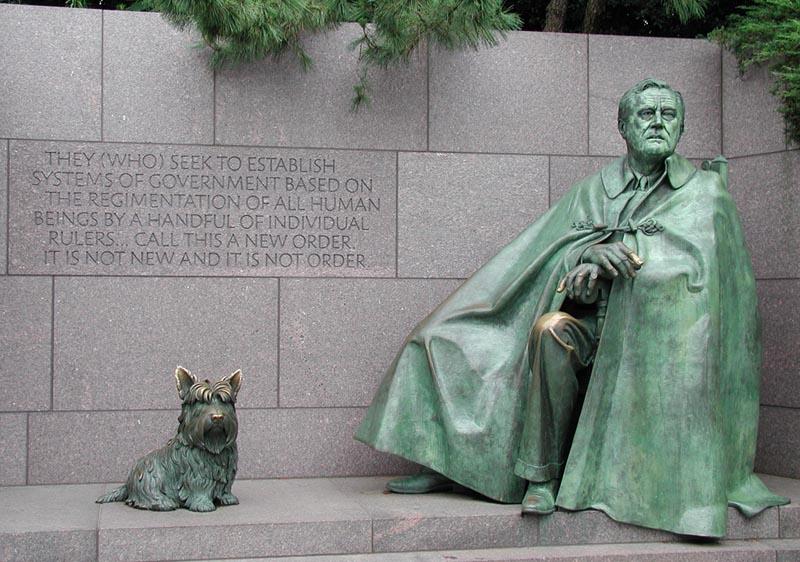
    „There is nothing so American as our national parks. The scenery and wildlife are native. The fundamental idea behind the parks is native. The parks stand as an outward symbol of this great human principle”. These sentences are not extracted from the platform of the American Green Party – they are from a quote of Franklin Delano Roosevelt, the 32nd President of the United States, a Republican. In his thinking, “conservation was closely tied to American Values” (Sussman/ Daynes/ West 2001: 169). During his governing period, environmental care was directly incorporated in governmental action – various agencies and bureaucracies were established to deal with this topic.

    FDR memorial in Washington with dog Fala
    FDR memorial in Washington with dog Fala

    Today, the United States reject major international environmental treaties such as the Kyoto Protocol, requiring participants to reduce green house gases below the 1990 level by 2012. The Bush administration has presented plans to drill for oil in the Arctic National Wildlife Refuge, a swathe of land in northeast Alaska, populated by migratory birds, wolves and caribou. The House of Representatives had already approved these plans, the Senate rejected them. In voting George W. Bush their 43rd President, a majority of the American people made their cross for a candidate with a green record tending to zero. But not only does environmental policy seem to have left the political agenda on a larger scale, observers more and more get the impression that the American people seem to care lesser for environmental aspects than ten or twenty years ago – only considering, among many other factors, the increasing number of polluting light trucks and SUVs on American roads.

    So can we conclude that, considering the fact that the parties fight for the support of the American mainstream, both Democrats and Republicans have banned environmental politics from their platforms? This paper is to figure out to what extent the field of environmental policy still is a factor in the American political landscape and what ideological and sociological factors are at play in this process and in the party-internal treatment of the topic.

    Table of Contents

    1. General Introduction

    1.1 Introduction and problem identification
    1.2 Approach of this term paper

    2. Environmental policy in the American discourse

    2.1 Ideological determinants
    2.2 Areas of Tension

    2.2.1 Economic efficiency vs. Ecology
    2.2.2 Sociogeographical variances

    2.2.2.1 Traditional labour versus modern production
    2.2.2.2 Translation into politics

    3. Parties and Positioning in the field

    3.1 Republicans: home for anti-environmentalists
    3.2 A “green” voting record in Congress: the Democrats
    3.3 The Green Party and environmental organizations

    4. Historical Perspective: Presidential performance

    4.1 “The Green Decade”
    4.2 The Eighties: Reagan and Bush
    4.3 Clinton and the 104th Congress

    5. Conclusion and outlook

    6. Bibliography

    I. General Introduction

    1.1 Introduction and problem identification

    „There is nothing so American as our national parks. The scenery and wildlife are native. The fundamental idea behind the parks is native. The parks stand as an outward symbol of this great human principle”. These sentences are not extracted from the platform of the American Green Party – they are from a quote of Franklin Delano Roosevelt, the 32nd President of the United States. In his thinking, “conservation was closely tied to American Values” (Sussman/ Daynes/ West 2001: 169). During his governing period, environmental care was directly incorporated in governmental action – various agencies and bureaucracies were established to deal with this topic. Today, the United States rejects major international environmental treaties such as the Kyoto Protocol, requiring signatories to reduce green house gases below the 1990 level by 2012. The Bush administration has presented plans to drill for oil in the Arctic National Wildlife Refuge, a swathe of land in northeast Alaska populated by migratory birds, wolves and caribou. The House of Representatives had already approved these plans, the Senate rejected them. In voting George W. Bush their 43rd President, a majority of the American people made their cross for a candidate with a green record tending to zero.

    But not only does environmental policy seem to have left the political agenda on a larger scale, observers are increasingly getting the impression that the American people seem to care less for environmental aspects than ten or twenty years ago – only considering, among many other factors, the increasing number of polluting light trucks and SUVs on American roads. So can we conclude that, considering the fact that the parties fight for the support of the American mainstream, both Democrats and Republicans have banned environmental politics from their platforms? Indeed, it is the needs of American public that party platforms should address, as a part of the identification of a problem or issue of salience and the formulation of a policy. If such a tendency becomes obvious, do the parties react in that way?

    1.2 Approach of this term paper

    This term paper is to figure out to what extent the field of environmental policy still is a factor in the American political landscape – putting special focus on the political parties. It is not concentrating on the various aspects of which environmental policy constitute, such as air and water preservation, energy politics and consumer protection, but it will make the differentiation if a certain issue requires it. In fact, environmental policy herein is treated only as a political subject, focussing on which party concentrated on it, when, to what degree, and what ideological and socio logical factors are at play in this process and in the internal party treatment of the topic. It starts with an attempt to elaborate a scheme of various areas of tension that are inherent in environmental politics in the United States, then it continues deducing how the parties fit within this texture. In the final part the paper takes a look in history, trying to find out if the scheme established in the middle part is confirmed by how the parties actually occupied this political area in the past and what their role was.

    2. Environmental politics in the American discourse

    2.1 Ideological determinants

    In comparison to most of the European countries, taking into consideration values and attitudes of the United States, the constellation of the political parties in the congress and the voting behaviour of the citizens, the United States can be called a conservative country. Socialism has been almost eradicated from the political map – only some left wing Democrats or small splinter parties nobody takes seriously still fancy with socialist ideas. Values like patriotism, family and religiousness have become mainstream attitude in the States – “moral values” for most Americans were the motivation to elect George W. Bush their President, who previously had been known as a Republican hardliner from Texas. “The environment is an issue without any obvious political home” John E. Bliese quotes Frances Cairncross of the Economist (2001: 10) – indeed, a statement from a theoretical point of view. However, in the environmental discussion in the USA, often sociological and ideological aspects are mingled into the debate. In the heads of most Americans, environment has a political home – it is a topic of quixotic anticapitalists, socialists and intellectuals. It has become mainstream thinking that somebody who cares for trees or animals has no idea of the problems of ordinary people.

    […]

    Continue reading on Hausarbeiten.de or contact me