term paper, winter semester 2007/2008, Potsdam University by Lars Dittmer
Preservation in all its facets in the United States stretches back over more than hundred years and over large parts of this period has enjoyed considerable support by public and politics. However, two decades after World War II, „as the nation shifted from an industrial to a postindustrial (or postmaterialist) society“ (Vig and Kraft: 9), national environmental groups have redefined their societal position. Organisations that had started as sometimes lose associations of anglers, hikers or birdwatchers, like the Sierra Club or the National Audobon Society, now formulated political stances taking into account a globalising world; after sometimes narrow-minded “Not in my backyard” projects and local initiatives of all kinds now consciousness for global issues like rain forest deforestation and climate warming arose. Preservation became environmentalism. (…) Also the scholar Rik Scarce reports skyrocketing membership figures in the environmental organisations during the Reagan years, a fact that will be highlighted later in this paper (22).
flag of the militant environmental NGO "Sea Sheperd" (source: Wikipedia)
It now could seem reasonable to argue that these new conditions were ideal for the movement – a clear enemy, topics that were neglected by the government and a seemingly consistent support from the public – but is that so easy? This term paper wants to find out if patterns of relationships between environmental groups and presidents in the United States exist. The points I will elaborate on in the body of my paper will include membership of the groups, foundation of new groups, radicalisation of the movement and public and financial support. I am basing my research on several assumptions – if a Presidency X fulfils the requirements Y, Z will happen to environmental groups. In the first part I will introduce some of the major organisations and their profiles, also some of the radical associations will be addressed. Also the presidencies and their environmental achievements will be part of my study, however only stretching back until the 1970s. Not all of the presidents will be scrutinised the same way; my focus will be especially on those administrations, whose elections marked clear turning points as to the environmental policies, politics and polities of the United States.
1. General Introduction
1.1 Introduction and problem identification
1.2 Assumptions
1.3 Other factors and influences
2. The two variables facts and backgrounds
2.1 Green organisations in the states
2.2 US-Presidencies and their green record
3. Results: organisations and the presidencies
3.1 Membership of the groups
3.2 Number of groups
3.3 Radicalisation of the groups
3.4 Support and Green giving
4. Conclusions
5. Bibliography
The movement feared for the worst, as Reagan’s victory could have indicated a falling sense for environmental topics in the society the result could have been a slump in membership and financial support and finally the dissolution of many groups. Their fears proved to be unfounded. „Paradoxically, Reagan actually strengthened environmental forces in the nation. Through his lax enforcement of pollution laws and prodevelopment resource
policies, he created political issues around which national and grassroots environmental groups could organize“ (Vig and Kraft: 14).
Also the scholar Rik Scarce reports skyrocketing membership figures in the environmental organisations during the Reagan years, a fact that will be highlighted later in this paper (22). It now could seem reasonable to argue that these new conditions were ideal for the movement a clear enemy, topics that were neglected by the government and a seemingly consistent support from the public but is that so easy?
This term paper wants to find out if patterns of relationships between environmental groups and presidents in the United States exist. The points I will elaborate on in the body of my paper will include membership of the groups, foundation of new groups, radicalisation of the movement and public and financial support. I am basing my research on several assumptions if a Presidency X fulfils the requirements Y, Z will happen to environmental groups. In the first part I will introduce some of the major organisations and their profiles, also some of the radical associations will be addressed. Also the presidencies and their environmental
achievements will be part of my study, however only stretching back until the 1970s. Not all of the presidents will be scrutinised the same way; my focus will be especially on those administrations, whose elections marked clear turning points as to the environmental policies, politics and polities of the United States.
term paper abstract, summer semester 2005, Potsdam university by Lars Dittmer
„There is nothing so American as our national parks. The scenery and wildlife are native. The fundamental idea behind the parks is native. The parks stand as an outward symbol of this great human principle”. These sentences are not extracted from the platform of the American Green Party – they are from a quote of Franklin Delano Roosevelt, the 32nd President of the United States, a Republican. In his thinking, “conservation was closely tied to American Values” (Sussman/ Daynes/ West 2001: 169). During his governing period, environmental care was directly incorporated in governmental action – various agencies and bureaucracies were established to deal with this topic.
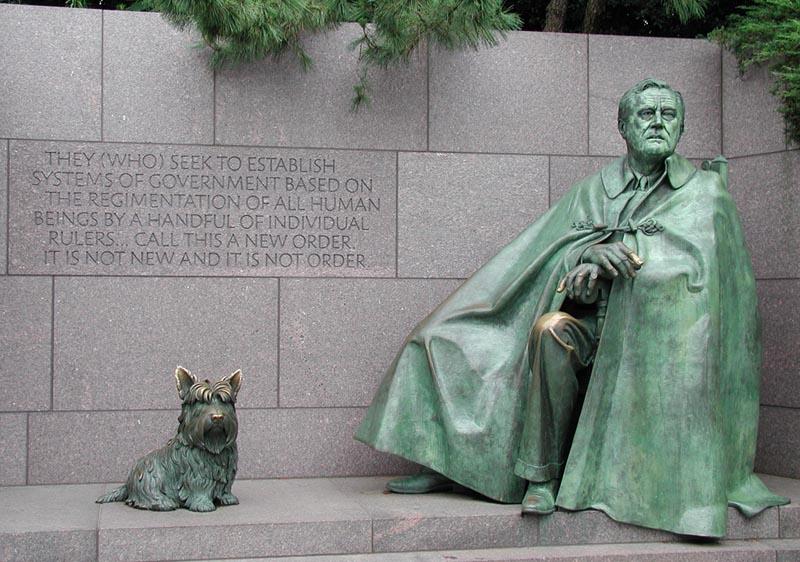
FDR memorial in Washington with dog Fala
Today, the United States reject major international environmental treaties such as the Kyoto Protocol, requiring participants to reduce green house gases below the 1990 level by 2012. The Bush administration has presented plans to drill for oil in the Arctic National Wildlife Refuge, a swathe of land in northeast Alaska, populated by migratory birds, wolves and caribou. The House of Representatives had already approved these plans, the Senate rejected them. In voting George W. Bush their 43rd President, a majority of the American people made their cross for a candidate with a green record tending to zero. But not only does environmental policy seem to have left the political agenda on a larger scale, observers more and more get the impression that the American people seem to care lesser for environmental aspects than ten or twenty years ago – only considering, among many other factors, the increasing number of polluting light trucks and SUVs on American roads.
So can we conclude that, considering the fact that the parties fight for the support of the American mainstream, both Democrats and Republicans have banned environmental politics from their platforms? This paper is to figure out to what extent the field of environmental policy still is a factor in the American political landscape and what ideological and sociological factors are at play in this process and in the party-internal treatment of the topic.
Table of Contents
1. General Introduction
1.1 Introduction and problem identification
1.2 Approach of this term paper
2. Environmental policy in the American discourse
2.1 Ideological determinants
2.2 Areas of Tension
2.2.1 Economic efficiency vs. Ecology
2.2.2 Sociogeographical variances
2.2.2.1 Traditional labour versus modern production
2.2.2.2 Translation into politics
3. Parties and Positioning in the field
3.1 Republicans: home for anti-environmentalists
3.2 A “green” voting record in Congress: the Democrats
3.3 The Green Party and environmental organizations
4.1 “The Green Decade”
4.2 The Eighties: Reagan and Bush
4.3 Clinton and the 104th Congress
5. Conclusion and outlook
6. Bibliography
I. General Introduction
1.1 Introduction and problem identification
„There is nothing so American as our national parks. The scenery and wildlife are native. The fundamental idea behind the parks is native. The parks stand as an outward symbol of this great human principle”. These sentences are not extracted from the platform of the American Green Party – they are from a quote of Franklin Delano Roosevelt, the 32nd President of the United States. In his thinking, “conservation was closely tied to American Values” (Sussman/ Daynes/ West 2001: 169). During his governing period, environmental care was directly incorporated in governmental action – various agencies and bureaucracies were established to deal with this topic. Today, the United States rejects major international environmental treaties such as the Kyoto Protocol, requiring signatories to reduce green house gases below the 1990 level by 2012. The Bush administration has presented plans to drill for oil in the Arctic National Wildlife Refuge, a swathe of land in northeast Alaska populated by migratory birds, wolves and caribou. The House of Representatives had already approved these plans, the Senate rejected them. In voting George W. Bush their 43rd President, a majority of the American people made their cross for a candidate with a green record tending to zero.
But not only does environmental policy seem to have left the political agenda on a larger scale, observers are increasingly getting the impression that the American people seem to care less for environmental aspects than ten or twenty years ago – only considering, among many other factors, the increasing number of polluting light trucks and SUVs on American roads. So can we conclude that, considering the fact that the parties fight for the support of the American mainstream, both Democrats and Republicans have banned environmental politics from their platforms? Indeed, it is the needs of American public that party platforms should address, as a part of the identification of a problem or issue of salience and the formulation of a policy. If such a tendency becomes obvious, do the parties react in that way?
1.2 Approach of this term paper
This term paper is to figure out to what extent the field of environmental policy still is a factor in the American political landscape – putting special focus on the political parties. It is not concentrating on the various aspects of which environmental policy constitute, such as air and water preservation, energy politics and consumer protection, but it will make the differentiation if a certain issue requires it. In fact, environmental policy herein is treated only as a political subject, focussing on which party concentrated on it, when, to what degree, and what ideological and socio logical factors are at play in this process and in the internal party treatment of the topic. It starts with an attempt to elaborate a scheme of various areas of tension that are inherent in environmental politics in the United States, then it continues deducing how the parties fit within this texture. In the final part the paper takes a look in history, trying to find out if the scheme established in the middle part is confirmed by how the parties actually occupied this political area in the past and what their role was.
2. Environmental politics in the American discourse
2.1 Ideological determinants
In comparison to most of the European countries, taking into consideration values and attitudes of the United States, the constellation of the political parties in the congress and the voting behaviour of the citizens, the United States can be called a conservative country. Socialism has been almost eradicated from the political map – only some left wing Democrats or small splinter parties nobody takes seriously still fancy with socialist ideas. Values like patriotism, family and religiousness have become mainstream attitude in the States – “moral values” for most Americans were the motivation to elect George W. Bush their President, who previously had been known as a Republican hardliner from Texas. “The environment is an issue without any obvious political home” John E. Bliese quotes Frances Cairncross of the Economist (2001: 10) – indeed, a statement from a theoretical point of view. However, in the environmental discussion in the USA, often sociological and ideological aspects are mingled into the debate. In the heads of most Americans, environment has a political home – it is a topic of quixotic anticapitalists, socialists and intellectuals. It has become mainstream thinking that somebody who cares for trees or animals has no idea of the problems of ordinary people.